
Sitting in a bar drinking a beer, have you ever wondered, ”What is in this drink that makes me feel so relaxed?” You probably already know the answer is alcohol, specifically ethanol, but have you ever wondered what exactly alcohol is? Alcohol molecules are organic molecules that contain an -OH group. This -OH group makes the molecule reactive, so it is called a functional group.
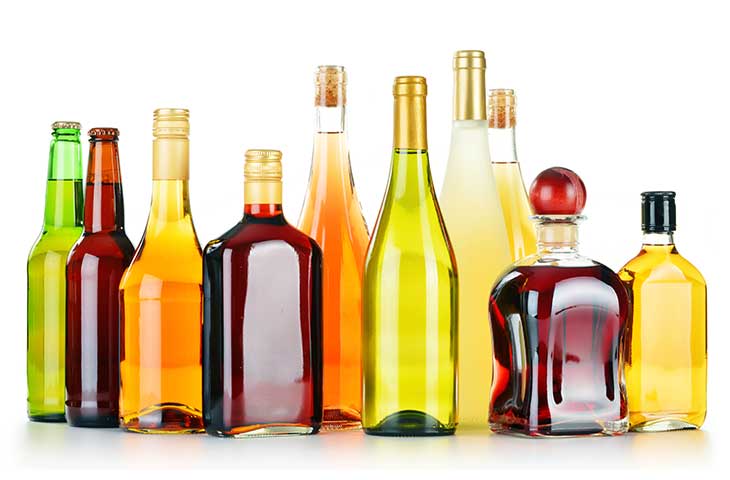
Alcohol functional groups are found in biological molecules such as sugars, amino acids, and vitamins. Alcohol functional groups are also found in molecules that are used every day. You can find ethanol in drinks like wine, beer, vodka, whiskey, gin, and rum, among many others. Ever had to check the antifreeze levels in your car? It contains ethylene glycol, another alcohol.
Nomenclature
The alcohol functional group hydroxyl is an -OH group. When naming alcohols, the -e is removed from the hydrocarbon name and an -ol suffix is added. A number in front of the hydrocarbon name tells the location of the alcohol group.
For example, in 1-butanol, there are four carbon atoms, so the parent hydrocarbon name is butane. The -e is dropped from butane and -ol is added, resulting in butanol. The 1 indicates the alcohol group is on the first carbon.
Alcohol Molecule Classification
Molecules can be classified based on the number of alcohol groups.
- monohydric -one alcohol group on the molecule
- dihydric – two alcohol groups on the molecule
- polyhydric – more than 2 alcohol groups on the molecule
Solubility
The number of alcohol groups that a molecule has will affect its solubility. As the number of alcohol groups increase on the molecule with the same number of carbons, the solubility in water increases. For example, 1,4-butandiol is more soluble in water than 1-butanol.
Another way to think about this is that as the number of carbon atoms increase in an alcohol, the solubility in water decreases. So, 1-octanol with eight carbons per alcohol group is less soluble in water than 1-butanol with four carbons per alcohol group.
 CHEMISTRY
Leave a comment